

Some days it feels like life is pulling in every direction, and you just need one honest moment to breathe and be thankful. Maybe you’ve been humming “praise God from whom all blessings flow” without knowing why it stirs your heart, or you’re searching for the words, the meaning, or the story behind them. Whatever brought you here, you’re not alone in wanting a little peace and a reason to smile today.
In this post, we’ll walk through what “praise God from whom all blessings flow” really means and where it comes from, in simple words anyone can follow. You’ll also find thoughtful reflections and easy ways to bring gratitude into your everyday life. Keep reading, and let’s discover together why these few words still bring comfort to so many hearts.
Praise God from Whom All Blessings Flow Lyrics
- “Praise God from whom all blessings flow” opens the doxology and names God as the source of every good thing.
- “Praise Him, all creatures here below” is the second line. It invites every living thing to join one chorus.
- “Praise Him above, ye heavenly host” is the third line. It lifts your eyes to the angels singing in glory.
- The final line praises the Trinity, then ends with a simple, peaceful Amen.
- The doxology words in short: thanks to God, praise from all creation, and glory to the Trinity.
- Sing the first line slowly this morning. Let each word remind you that nothing you hold arrived by accident.
- Four short lines hold an entire sermon, which is why the doxology lyrics stay easy to memorize.
- When you sing “Praise Him, all creatures here below,” picture birds, oceans, and neighbors joining the same song of praise.
- Whisper the lyrics before a meal and your dinner table becomes a small altar of gratitude.
- Children learn the doxology words quickly because the rhythm is steady and the rhymes are easy.
- The Old Hundredth doxology tune carries these words in a slow, even rhythm congregations can sing with or without instruments.
- Hymnals often print the verse under the heading “Doxology,” so look for that word in your church songbook.
- Try singing the verse in a whisper at bedtime while thanking God for one gift from your day.
- You don’t need a trained voice to sing this traditional Christian hymn. A quiet, honest heart is enough.
- These lines work as a hymn of praise and as a short prayer you can speak in one breath.
- Many churches sing the verse right after the offering, turning gifts of money into heartfelt praise.
- Praise God blessings flow stays timeless because it asks nothing for you and gives everything back to God.
- If you’re learning this traditional hymn for the first time, add one new line each day.
- Prayer: Giver of every good gift, I sing your praise today. Let my voice and my life honor you. Amen.
- Prayer: God, teach my heart to sing “Praise Him, all creatures here below,” even when my voice feels small. Amen.
Read More: 135 African American Monday Blessings GIFs with Prayers & Quotes
What Does Praise God from Whom All Blessings Flow Mean?
- At its heart, praise God from whom all blessings flow means every good gift in your life traces back to God.
- The words “blessings flow” paint a picture of a river that never runs dry.
- To praise God here means to speak or sing your thanks aloud instead of only feeling it quietly.
- The line puts gratitude first and requests second. God has already given far more than you’ve noticed.
- “From whom” points to a person, not luck or a force. Blessings come from a living God who cares.
- The meaning of the word doxology comes from Greek roots joining “glory” and “word.” It literally means a word of glory.
- A Christian doxology is a short burst of praise, usually placed at the end of a prayer or hymn.
- Praising God as the source of every blessing keeps pride small and thankfulness big, even after hard work.
- The line also teaches humility. Your talents, your health, and your daily bread all arrive as gifts you didn’t earn.
- When life hurts, the phrase still stands. It invites you to look for the small mercies God places around your pain.
- “Praise Him, all creatures here below” widens the meaning: praise is a shared song of all creation.
- This hymn of gratitude to God ends by naming the Trinity, which means your praise reaches every person of God.
- Is it a prayer or a hymn? It’s both. You can sing it with a congregation or whisper it alone.
- Acknowledging God’s gifts and provision doesn’t ignore hardship. It simply notices what remains good while you walk through it.
- Each time you pray “praise God, all blessings flow,” you rehearse the habit of seeing grace before you see lack.
- The words teach that blessings aren’t rewards for perfect people. They’re expressions of God’s generosity toward everyone who receives them.
- Prayer: God, open my eyes to the gifts I rush past. Amen.
- Prayer: Thank you, God, for daily bread, good health, and people who love me. Amen.
- Prayer: When life hurts, God, help me find one small mercy and thank you for it. Amen.
- Prayer: Humble my pride, God, and remind me that every talent I hold is your gift. Amen.
Who Wrote Praise God from Whom All Blessings Flow?

- Thomas Ken, an English bishop and hymn writer, is traditionally credited with writing the doxology’s text in 1674.
- Ken was born in 1637 in Hertfordshire. He grew up reading Scripture and devotional writings.
- He studied at Winchester College and later at Oxford, building a lifelong love of learning, prayer, and worship.
- Ken later served as a chaplain and eventually became Bishop of Bath and Wells, caring for people across Somerset.
- He wrote the verse as the closing stanza of three hymns for Winchester boys: morning, evening, and midnight.
- Ken urged students to sing these hymns in their rooms, treating praise as a daily habit.
- His hymns reached a wider audience when printed in later editions of his prayer manual for Winchester scholars.
- Ken lived simply and gave generously to the poor. That generosity made his words about blessings ring true.
- In 1688 he joined six other bishops in petitioning King James II, which briefly sent him to the Tower of London.
- After he refused to swear loyalty to William and Mary in 1689, Ken lost his bishopric but kept praying.
- His story shows that praise can stand firm when comfort, titles, and security fall away.
- Ken died in 1711 and was buried at Frome in Somerset, leaving behind a legacy of simple, faithful worship.
- He wrote many hymns, yet the doxology outlived them all and now rings in churches around the world.
- Some hymnals credit him by name; others list the verse as “traditional,” so check the footnote.
- Ken wrote the lines as a closing flourish. He never imagined four short lines would travel across centuries.
- The famous words belong to Ken, but the melody comes from another source entirely: the Old Hundredth tune.
- If you’ve ever asked who wrote praise God from whom all blessings flow, the answer is Thomas Ken, a humble bishop.
- His example reminds you that great hymns often begin as quiet prayers written by ordinary people.
- Pray today for courage to give thanks as Ken did: steady in comfort and steady when life gets hard.
- Ken was known to sing his morning hymn to the lute before daybreak, giving thanks before the day’s work began.
Read More: Monday Morning Blessings and Prayers: 150+ Uplifting Messages
The History and Origin of the Doxology
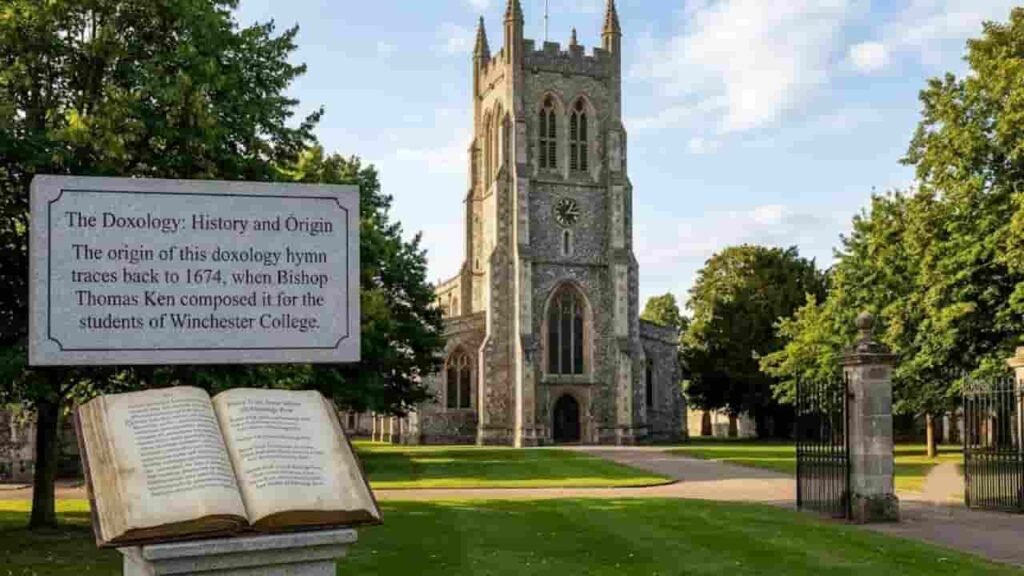
- The origin of the doxology hymn traces back to 1674, when Ken composed it for the students of Winchester College.
- It first appeared as the last stanza of his morning, evening, and midnight hymns, with nearly identical wording in each.
- For decades the verse traveled quietly inside Ken’s longer hymns before churches began singing it on its own.
- Congregations eventually detached the final stanza because those four lines worked beautifully as a complete prayer of praise.
- The Old Hundredth tune comes from the Genevan Psalter of 1551 and is commonly linked with the composer Louis Bourgeois.
- That tune first served Psalm 100, which explains the name Old Hundredth and its close ties to thanksgiving.
- Over time, English-speaking churches paired Ken’s words with that melody. The combination stuck and never let go.
- Reformation singing traditions shaped the sound, favoring simple tunes that ordinary people could learn without sheet music.
- Anglican and Puritan communities both loved short songs of praise, so the verse crossed denominational lines early.
- Later Protestant worship traditions in Britain and North America adopted the doxology as a standard closing to services.
- Early American congregations often sang it by “lining out,” where a leader called each line and the people echoed it.
- Hymn editors have adjusted small words across the centuries, so you may notice differences between older and newer hymnals.
- In the 1800s the verse became a fixture of Sunday worship, often sung right after the offering was presented.
- Revival meetings and camp gatherings spread the words widely because crowds could learn four short lines on the spot.
- By the twentieth century, radio broadcasts and recordings carried the doxology into homes far from any church building.
- Today translators have rendered it in many languages, so believers on every continent can sing the same praise.
- Its long history shows how a prayer written for schoolboys can become a worldwide expression of Christian faith.
- Many writers describe the doxology as among the most widely sung stanzas in English-language worship.
- The history of praise God from whom all blessings flow also reveals that simple words often outlast ornate ones.
- Picture a congregation in the 1700s: candlelight, wooden pews, and four familiar lines rising together in a single voice.
Biblical Meaning of Praise God from Whom All Blessings Flow
- James 1:17 says every good and perfect gift comes from above, which mirrors the doxology’s opening line beautifully.
- 1 Chronicles 29:11 declares that greatness, power, glory, and majesty belong to God, echoing the call to give glory to God.
- Psalm 150 closes the Psalter with a call for everything that breathes to praise the God, matching “Praise Him, all creatures.”
- Psalm 103:1–5 urges you to remember God’s benefits: forgiveness, healing, redemption, and a life satisfied with good things.
- The phrase “heavenly host” echoes Bible scenes where angels celebrate God’s work, including the song.
- The closing line reflects New Testament teaching that God is one yet known in three persons: a true Trinitarian doxology.
- Matthew 28:19 commands baptism in the name of the three persons of the Trinity, which supports the hymn’s final line.
- Romans 11:36 says all things come from God, through God, and to God. It pairs perfectly with the first line.
- Ephesians 3:20–21 gives glory to the One who can do far more than you ask or imagine.
- Revelation 5:13 pictures every creature in heaven and earth offering blessing and honor, mirroring the hymn’s wide circle of praise.
- Biblical doxologies appear at the end of many letters, so Ken followed an ancient pattern when closing his hymns.
- Jude 24–25 ends with glory, majesty, dominion, and power to God. It’s a classic doxology straight from Scripture.
- The biblical meaning of the doxology hymn is that blessings are gifts of grace rather than wages for good behavior.
- Psalm 100 invites you to enter God’s gates with thanksgiving, which fits the Old Hundredth tune’s own Scripture roots.
- Giving glory to God, as the Bible describes it, means honoring God’s character and deeds instead of boasting in your own.
- Deuteronomy 8:18 tells you to remember God as the One who gives the power to gain wealth. The doxology keeps that fresh.
- Psalm 145 praises God’s greatness daily and forever, showing that thanksgiving belongs in every season of life.
- Colossians 3:17 encourages you to do everything with thanks to God, turning ordinary work into worship.
- When you pray praise God from whom all blessings flow, you echo a theme that stretches from Genesis to Revelation.
Why Christians Sing the Doxology in Worship
- Christians sing the doxology because praise is the natural response when you realize how much God has given.
- Singing together unites a congregation, turning many separate voices into one song of Christian worship and praise.
- The hymn fits the end of a service because it gathers everything shared and returns it to God.
- Many churches sing it after the offering, reminding people that money, time, and talent all belong to God first.
- In Christian liturgy a doxology often marks a transition, signaling that one part of worship has finished.
- The short length makes it easy for newcomers, children, and elderly members to join without needing a hymnal.
- Repeating it every week builds a rhythm of gratitude, much like a steady heartbeat beneath the whole service.
- Traditional church hymns carry memory. When you sing this one, you stand beside believers from centuries ago.
- Why do Christians sing the doxology? It teaches theology gently, naming God as giver and the Trinity as worthy of praise.
- For many families, hearing it in church brings back childhood Sundays. That makes praise feel warm and familiar.
- It crosses denominations, so visiting an unfamiliar church often feels like coming home once the first notes begin.
- Congregational singing teaches you to listen as well as sing, matching the pace of those near you.
- Singing the doxology when life feels heavy can steady your heart without denying your pain.
- The hymn gives a shared voice to people who can’t find words for their own gratitude.
- Pastors often choose it as a closing hymn, sending people into the week with praise still ringing in their ears.
- Praise God from whom all blessings flow in worship keeps God at the center instead of the program.
- Prayer: God, bind our voices together this Sunday. Let our praise lift every weary heart. Amen.
- Prayer: God, carry these words with us into our homes, our work, and our week ahead. Amen.
- Prayer: Thank you, God, for believers who sang before us. Help us teach this song to our children. Amen.
Bible Verses About Praising God for His Blessings

- Psalm 103:2 captures praise God from whom all blessings flow in one line: bless the God and forget not his benefits.
- Psalm 34:1 says, “I will bless God at all times: his praise shall continually be in my mouth.”
- Psalm 118:24 reminds you that this is the day God has made, so rejoice and be glad in it.
- 1 Thessalonians 5:18 urges you to give thanks in every circumstance, because that is God’s will for you.
- Psalm 100:4 invites you to enter his gates with thanksgiving and his courts with praise.
- Psalm 136:1 calls you to give thanks to God for he is good; his mercy endures forever.
- Psalm 28:7 says God is your strength and shield, and a trusting heart answers with songs of thanks.
- Psalm 145:1–2 promises to extol God as King and to bless his name every single day.
- Philippians 4:6 invites you to bring every request to God with thanksgiving, trusting that peace will guard your heart.
- Colossians 2:7 encourages roots that grow deep in faith, with a life overflowing with thankfulness.
- Psalm 116:12 asks a lovely question: “What shall I render unto God for all his benefits toward me?”
- Hebrews 13:15 calls you to offer God a continual sacrifice of praise, the fruit of lips that give thanks.
- Psalm 95:2 says to come before God with thanksgiving and make a joyful noise with songs of praise.
- Ephesians 5:20 urges you to give thanks always for everything to God.
- Prayer from Psalm 103: God, my soul blesses you today. I won’t forget your forgiveness, healing, and kindness. Amen.
- Prayer from Psalm 34: God, I will bless you at all times. Keep your praise in my mouth, in joy and sorrow. Amen.
- Prayer from Philippians 4:6: God, I bring my worries to you with thanks. Guard my heart with your peace. Amen.
- Prayer from Psalm 136: Thank you, God, for you are good and your mercy lasts forever. Amen.
- Prayer from Hebrews 13:15: God, accept my praise as an offering today. Let my lips always speak thanks to you. Amen.
How to Use the Doxology in Prayer and Thanksgiving

- Open your morning prayer by whispering the first line, then name three blessings you’re thankful for today.
- Use all blessings flow as a closing prayer for your quiet time, followed by a calm Amen.
- Before dinner, sing or speak the verse as a family grace, and let each person add one thank-you.
- When you feel anxious, repeat “Praise God from whom all blessings flow” slowly until your breathing settles.
- Keep a gratitude journal and copy the first line at the top of each page as your daily prompt.
- During hard seasons, pray only the first line and sit in silence. Sometimes gratitude begins with a single sentence.
- Teach children to use the doxology as a bedtime prayer, ending the day with praise and thanks.
- At work, silently pray the opening words before a big meeting, trusting God to supply wisdom and calm.
- When you give an offering, say the line quietly to remind yourself that you’re returning what God first gave.
- Morning prayer: God, thank you for this new day. Help me notice your gifts and give you glory. Amen.
- Mealtime prayer: Thank you, God, for this food and the hands that prepared it. Bless our table. Amen.
- Prayer for peace: God, quiet my racing thoughts. I trust that every good thing I need comes from you. Amen.
- Prayer in grief: God, thank you for the years I shared with those I love. Hold me gently now. Amen.
- Family prayer: God, bless our home with laughter, patience, and gratitude for every good gift. Amen.
- Prayer for work: God, guide my hands and words today. Let my effort become a quiet song of praise. Amen.
- Prayer for hard days: God, I don’t understand everything, but I still thank you for your faithful love. Amen.
- Prayer for others: God, bless my friends and neighbors with your peace and goodness today. Amen.
- Offering prayer: God, I give back a small part of what you gave me. Use it for your glory. Amen.
- End each night with this prayer: “Thank you, God, for today’s gifts. Amen.”
FAQs
What does the first line of the doxology mean?
To praise God from whom all blessings flow means every good gift comes from God, so you respond with thanks.
Who wrote the doxology?
Thomas Ken, an English bishop, wrote praise God from whom all blessings flow in 1674 for students at Winchester College.
Is the doxology a prayer or a hymn?
It’s both. Congregations sing praise God from whom all blessings flow as a hymn, and you can speak it as a short prayer.
Why do Christians sing the doxology in church?
It gathers a congregation’s gratitude into one short song, so people praise God from whom all blessings flow after the offering or at the close of worship.
What is the connection between the doxology and the Old Hundredth?
The Old Hundredth is the tune most churches use for praise God from whom all blessings flow, and it first carried Psalm 100 in the 1500s.
Conclusion
The doxology proves that a few simple words can carry deep faith. Now you know the lyrics, the story of Thomas Ken, the biblical roots, and the reasons Christians keep singing this hymn. Praise God from whom all blessings flow has outlasted centuries because it points every heart back to the Giver.
Try it today. Whisper the first line at sunrise, sing it with your church, or pray it at bedtime. Let thanks shape your ordinary days, and remember to praise God from whom all blessings flow, because every good gift comes from God, as written in James 1:17.

PrayersCompass is a welcoming place for prayers, blessings, and faith-filled messages. The site is managed by Caleb, an experienced SEO content writer with 2 years of expertise in creating meaningful content.