

Every year when the first candle is about to be lit, I get that little flutter of panic: wait, which words am I supposed to say again? If you’ve ever stood there with a match in your hand, hoping you remember the Hanukkah blessings correctly, you’re definitely not alone. It’s one of those moments where you just want to get it right, for your family, for the tradition, and for yourself.
In this post, I’ll walk you through the Hanukkah blessings in a simple, easy-to-follow way, including what each one means and when to say it. You’ll get the Hebrew, the transliteration, and the English translation, so you can feel confident whether it’s your first night of Hanukkah or your fiftieth. Let’s get you ready to light those candles with ease.
The 3 Traditional Hanukkah Blessings for Candle Lighting
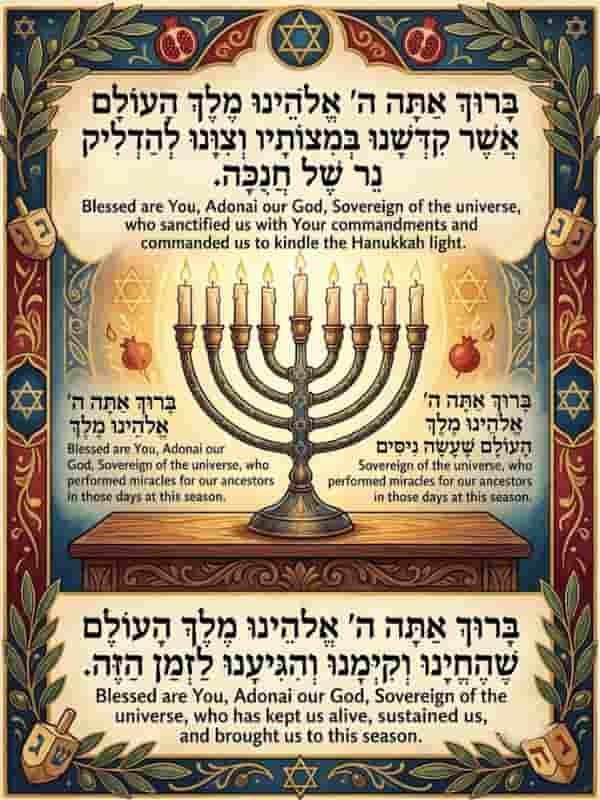
- First blessing, Lehadlik Ner Shel Hanukkah: “Blessed are You, Adonai our God, King of the universe, who sanctified us with commandments and told us to kindle the Hanukkah light.”
- Second blessing, She’asah Nissim: “Blessed are You, Adonai our God, King of the universe, who performed miracles for our ancestors in those days, at this season.”
- Third blessing, Shehecheyanu, said on the first night only: “Blessed are You, Adonai our God, King of the universe, who kept us alive and brought us to this moment.”
- Together, these Hanukkah blessings honor the mitzvah itself, the miracle behind it, and the gift of simply being here to celebrate.
- May the first candle remind you that one small, steady flame can push back a surprising amount of darkness.
- God, as this light grows night after night, let our home grow with it in patience, laughter, and open doors.
- I light this flame for the people missing from our table. May they feel our warmth wherever they are.
- Let every candle in the hanukkiah carry one quiet hope for someone you love, spoken softly before you strike the match.
- Bless our kitchen with the smell of frying latkes, and bless our conversations with kindness that lasts past dessert.
- May we remember that courage rarely looks dramatic. Sometimes it looks like lighting a candle when the world feels dim.
- God, thank You for this season, for the children bouncing near the window, and for the elders who taught us the words.
- Let the shamash teach us how to serve, giving light to others without losing any of our own.
- Before the match touches the wick, take a slow breath. Let the traditional prayers turn a rushed evening into a sacred one.
- May our candles shine beyond the windowsill and nudge the neighbors, the strangers, and the weary toward a little hope.
- Grant us the humility to say thank you first and the strength to keep the lights burning after the holiday ends.
- Today we stand where generations stood, speaking old words in new kitchens and trusting the flame to carry them forward.
- May the eight nights ahead soften an old argument, mend a quiet distance, and invite someone back to the table.
- God, guide our hands as we light, and guide our hearts as we remember why these small flames still matter.
Read More: 150+ Christmas Blessings, Images, Quotes, and Wishes to Share
Hanukkah Blessings in Hebrew, English, and Transliteration
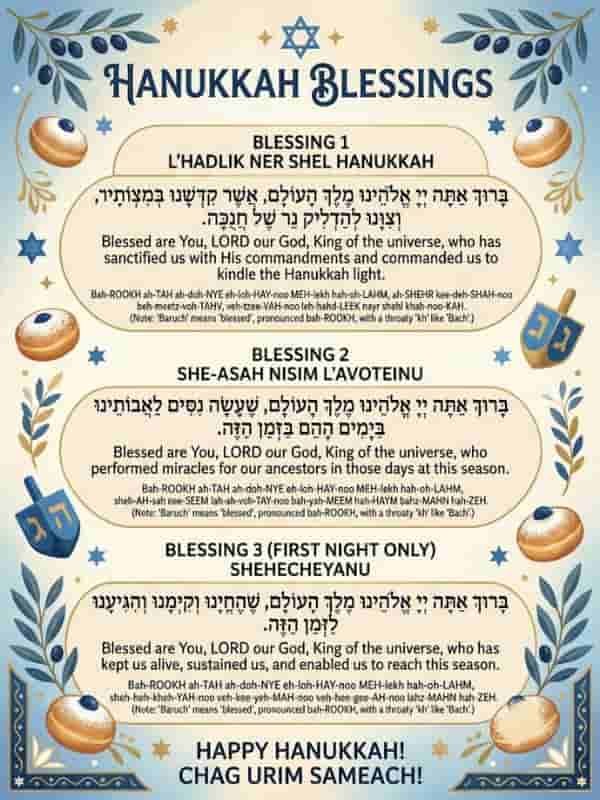
- Baruch (ברוך) means “blessed.” Say it as bah-ROOKH, with a soft, throaty “kh” like the end of “Bach.”
- Atah (אתה) means “You.” Pronounce it ah-TAH, and keep both syllables open and even.
- Adonai is a name of God. Say ah-doh-NYE during prayer, though many people say “Hashem” in everyday conversation.
- Eloheinu means “our God.” Say eh-loh-HAY-new, with the stress landing on the third syllable.
- Melech ha’olam means “King of the universe.” Say MEH-lekh hah-oh-LAHM, and let the “kh” ring again.
- Asher kid’shanu b’mitzvotav means “who sanctified us through His commandments.” Say ah-SHER kid-SHAH-new b’meetz-voh-TAHV.
- V’tzivanu means “and commanded us.” Try v’tzee-VAH-new, and don’t rush the “tz,” which sounds like the end of “pizza.”
- L’hadlik means “to kindle.” Say l’had-LEEK, then pause briefly to prepare for the key phrase that follows.
- Ner shel Hanukkah means “the light of Hanukkah.” Say NAIR shel khah-noo-KAH, with a gentle breath on the first sound.
- In Hebrew letters, that final phrase appears as נר של חנוכה, read right to left, just like the whole prayer.
- She’asah nissim means “who performed miracles.” Say sheh-ah-SAH nee-SEEM, and linger slightly on the last syllable.
- La’avoteinu means “for our ancestors.” Try lah-ah-voh-TAY-new, and picture the generations behind you as you say it.
- Bayamim hahem means “in those days.” Say bah-yah-MEEM hah-HEM, with the same breathy “h” you’d use in “hello.”
- Bazman hazeh means “at this time.” Say bahz-MAHN hah-ZEH, which gives the line a pleasant, steady rhythm.
- Shehecheyanu means “who has kept us alive.” Say sheh-heh-kheh-YAH-new, and take it one chunk at a time.
- V’kiy’manu v’higi’anu lazman hazeh means “sustained us and brought us to this season.” Say v’kee-y’MAH-new v’hee-gee-AH-new lahz-MAHN hah-ZEH.
- For a clean transliteration guide, write each phonetic chunk on an index card and tape it beside the menorah.
- Beginners can read the Hanukkah blessings in Hebrew with English translation by printing two columns, with the Hebrew on the right.
What Do the Hanukkah Blessings Mean?
- The first blessing turns a simple act into a mitzvah. You aren’t just lighting candles. You’re fulfilling a commandment.
- “Who sanctified us” suggests that ordinary moments can become holy when we approach them with intention.
- Blessings before performing a mitzvah follow an old rule: pause, acknowledge the purpose, and only then act.
- The second blessing looks back. It recalls the miracles that saved the Jewish people during the Maccabean revolt.
- “In those days, at this season” ties two moments together, joining an ancient victory to your living room tonight.
- The Maccabees reclaimed Jerusalem and rededicated the Second Temple. That moment sits at the heart of the holiday.
- The miracle of the oil adds another layer. One day’s supply reportedly burned for eight days, which explains the eight nights.
- The third blessing, Shehecheyanu, is about gratitude. It thanks God for keeping you alive long enough to reach this night.
- Why only on the first night? Because the thrill of a new season arrives once, at the very start.
- Hanukkah blessings also act as a memory tool. Saying the same words each year links you to everyone who said them before.
- Notice that the second blessing credits “our ancestors.” Even if your family tree looks different, the phrase invites you into a shared story.
- Notice that don’t ask for favors. They praise, remember, and thank, which makes them a gentle way to begin a celebration.
- The word “ner” means light, but it hints at more than fire. Light stands for wisdom, hope, and resilience.
- Saying the words aloud matters. Speech turns private feeling into something your whole household can hear and share.
- Rabbinic tradition stresses publicizing the miracle, called pirsumei nisa, which is why blessings and windows go together.
- The meaning stays the same in any language. Understanding the English helps children connect with the Hebrew they’re learning to say.
- Some people hear the three blessings as a story arc: duty, history, and gratitude. Notice how neatly they build.
- Miracles in this tradition aren’t only dramatic events. They include the quiet persistence of a small group who refused to give up.
Read More: 125 Religious Good Morning Blessings, Prayers & Quotes
How to Say the Hanukkah Blessings Step by Step
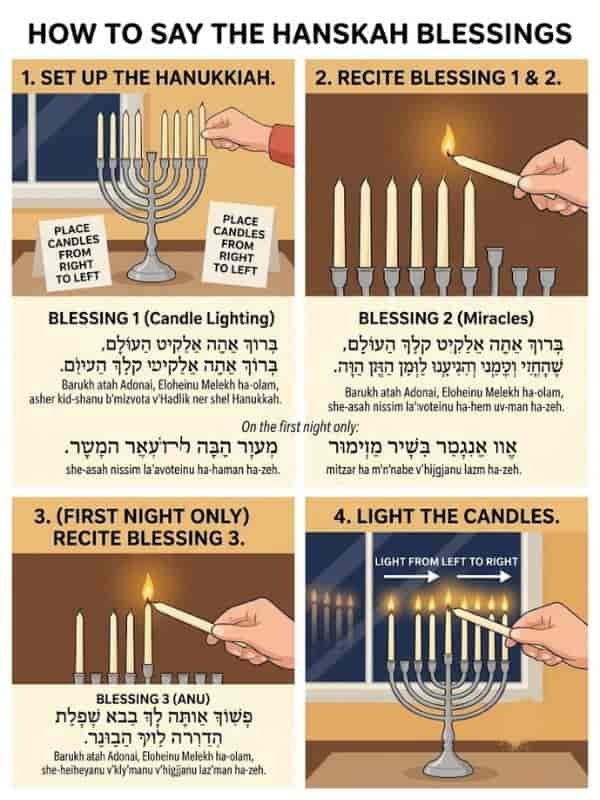
- Set up the hanukkiah first. Place it where the flames will be visible, ideally near a window or doorway.
- Add candles from right to left. On night one, you need just one candle plus the shamash.
- Pick up the shamash, the helper candle, and light it first. It will light the rest.
- Hold the shamash in your right hand and pause. Everyone gathered should be quiet and ready.
- Recite the first blessing, Lehadlik Ner Shel Hanukkah, before you light any candle. The blessing always comes first.
- Follow it with She’asah Nissim straight away. Don’t pause to chat between the two blessings.
- On the first night, add Shehecheyanu before you light. It joins the others in one smooth sequence.
- Now touch the shamash to the newest candle, which is the one farthest left.
- Light the remaining candles from left to right, so each new one gets its moment.
- Return the shamash to its spot, slightly above or apart from the other candles.
- Don’t use the flames for reading or cooking. Their only job is to be seen and remembered.
- Sing or read Hanerot Halalu right after lighting, while the candles are still fresh and the room is quiet.
- Keep a lighter or long match nearby. Fumbling for fire after the blessing can break the moment.
- Reading from a card is perfectly fine. Nobody expects you to memorize the Hebrew by heart on night one.
- Let kids take turns lighting the shamash, with an adult nearby. Responsibility sticks when children feel included.
- Keep the Hanukkah blessings short and steady. A calm, clear pace beats a fast recital every time.
- Make sure the candles can burn for at least half an hour after nightfall. Use proper-length candles or enough oil.
- Never leave lit candles unattended near curtains, paper decorations, or curious pets. Safety is part of the mitzvah.
Which Blessings Do You Say on Each Night of Hanukkah?

- Night one: Say all three blessings and light one candle plus the shamash. This is the only night with Shehecheyanu.
- Night two: Say the first two blessings, add a second candle, and light the newest one first.
- Night three: Recite the same two blessings, then light three candles. Shehecheyanu stays quiet until next year.
- Night four: Same two blessings, four candles. By now, the words usually feel familiar even to beginners.
- Night five: The ritual holds steady. Light five candles after the two blessings and enjoy the growing glow.
- Night six: Two blessings, six candles. The light now fills most of the windowsill and spills into the room.
- Night seven: Recite the two blessings again and light seven candles. Notice how crowded the hanukkiah looks.
- Night eight: The same two blessings apply, then eight candles plus the shamash. It’s a brilliant finish.
- So how many are said each night? Two on nights two through eight, and three on night one.
- Count the flames: night one has two lights counting the shamash, and night eight has nine.
- By the end of the holiday, you’ll have lit 44 flames in total, including every shamash.
- If you miss the first night, say Shehecheyanu on the first night you do light the candles.
- Traveling? Say the same blessings wherever you light your candles. Your location doesn’t change the words.
- Those wondering whether Hanukkah blessings change nightly can relax. Only the Shehecheyanu appears once and then steps aside.
- Parents often write a small chart on the fridge showing the night, candle count, and blessings.
- Let a different family member lead each night. Seeing everyone try builds confidence for the whole group.
- Think of nights two through eight as steady practice. Repetition makes the Hebrew stick faster than any flashcard.
- Some families add a short personal wish after the formal words. A single sentence keeps it meaningful.
When Is the Best Time to Recite Hanukkah Blessings?
- Light your candles after nightfall on most evenings. That’s when the miracle story traditionally comes alive.
- Say the blessings right before lighting, never afterward. Blessings belong ahead of the mitzvah, not after it.
- Customs differ on exact timing. Ask your rabbi whether your community lights at sunset or when stars appear.
- Aim for a window of roughly half an hour after dark. Candles must burn long enough for passersby to notice.
- On Friday evening, light the Hanukkah candles first. Do it well before sunset, then light Shabbat candles.
- Friday candles need extra staying power. Choose longer ones so they last past nightfall without anyone touching a match.
- On Saturday night, wait until Shabbat ends. Then say the blessings and light, following whichever Havdalah order your community uses.
- Running late from work? Light as soon as you get home, as long as people are still up and about.
- Waiting for the family helps. If one person is traveling home, wait a little so they can join.
- Don’t rush because dinner is ready. Food can wait ten minutes while you do the important thing first.
- For a family with little kids, an earlier lighting at the start of the window avoids sleepy faces.
- Morning is not the time for candles. Save the glow for the evening hours when darkness gives it meaning.
- In the synagogue, communities often light at a set time alongside the evening service.
- Hanukkah blessings work best when everyone’s phone is silent. Even two quiet minutes make the moment stronger.
- Set a phone alarm for the first night. A gentle reminder beats scrambling when the sun has already set.
- Consider a quick prep ritual: wash hands, find the matches, set out the candles, and gather everyone before the light fades.
- Winter days end early, so evening lighting often falls between dinner and homework time in many homes.
- If a power outage or storm hits, light anyway. Flames are the whole point of the mitzvah.
Hanukkah Prayers and Songs After Lighting the Candles
- Hanerot Halalu is the first text most people recite after lighting. It begins with “We kindle these lights.”
- It explains that the candles are holy and shouldn’t be used for ordinary tasks, only for gazing and gratitude.
- The text mentions miracles, salvations, and wonders performed for our ancestors through the priests.
- Maoz Tzur, often translated “Rock of Ages,” follows and has been sung in Jewish homes for centuries.
- Its verses recount a pattern of rescue, from ancient Egypt to the Maccabean victory and beyond.
- Many families sing only the first verse. That’s perfectly fine because a short song still carries the tune forward.
- Al Hanissim is a prayer inserted in daily services and after meals, thanking God for the miracles and victories.
- Within the grace after meals, Al Hanissim adds Hanukkah’s story to your dinner table.
- Hallel, a collection of psalms of praise, is recited during morning services on all eight days.
- Synagogue prayers for Hanukkah add Al Hanissim to the Amidah, so the miracle echoes in every service.
- Beyond the liturgy, you can enjoy songs like “I Have a Little Dreidel” with kids after the candle lighting.
- Another favorite is “Hanukkah, Oh Hanukkah,” a lively folk melody perfect for dancing around the table.
- Sing slowly at first. Clear pronunciation helps newcomers and a steady tempo helps everyone join in.
- Use song sheets with transliteration so guests who don’t read Hebrew can still raise their voices.
- After the Hanukkah blessings and candle songs, many families sit quietly for a minute and watch the flames.
- Tell the story of the Maccabees in a few sentences before dessert to ground the singing in history.
- Gift giving, dreidel games, and gelt often follow the songs, turning reverence into play.
- Cantors in many synagogues lead the congregation in Maoz Tzur at the end of the service.
Hanukkah Blessings for Family and Friends

- Wishing you eight nights of warm light, good food, and the kind of laughter that makes your ribs ache.
- May your hanukkiah glow brightly and your table stay full of people who love you.
- Sending you a candle’s worth of hope for every night. May each flame be brighter than the last.
- I hope this Festival of Lights brings you peace, a little fried food, and plenty of unhurried time.
- May the miracle of the oil remind you that small efforts can outlast every expectation.
- To my friends far away: I’m lighting a candle for you tonight. Look for the flicker in your window.
- Here’s to children who grow up proud of their traditions and curious about the stories behind them.
- Grandma, thank you for passing down the songs. Every candle I light carries your voice.
- Wishing you courage in hard moments, kindness in ordinary ones, and joy in the moments that feel magical.
- May this holiday soften every worry, melt away old tension, and leave your home cozy and bright.
- Dear neighbors, may our windows glow together this week. Light shines farther when we share it.
- Happy Hanukkah to a friend who teaches me persistence. Your spark keeps my own flame going.
- May your latkes be crisp, your applesauce sweet, and your family argue only about who gets seconds.
- Sending Hanukkah blessings your way, with love for everything you’ve endured and everything still to come.
- May the lights remind you that you’re never as alone as the long winter nights make it seem.
- Whatever you’re carrying this season, may these eight nights lighten it by at least one candle’s worth.
- To the new parents lighting candles for the first time: may your baby’s first Hanukkah become a favorite story.
- May this year’s blessings find you healthy, grateful, and surrounded by people who bring out your best.
Hanukkah Customs and Differences in Jewish Traditions
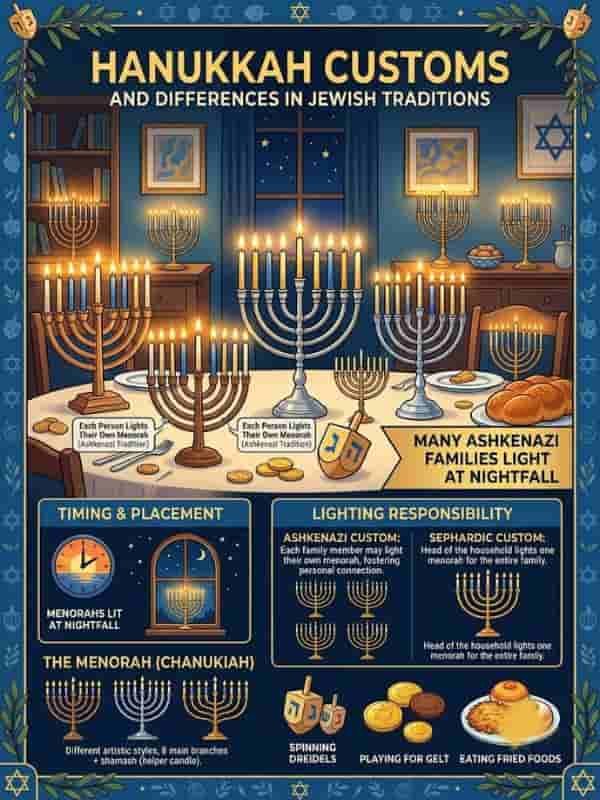
- Many Ashkenazi families light at nightfall and encourage each person to light their own menorah.
- Sephardi households commonly light one menorah on behalf of the whole family, with the head of the household leading.
- Pronunciation shifts across communities. An Ashkenazi “Hanukkah” may sound a bit different from a Sephardi or Israeli one.
- Many traditions prefer olive oil, since it echoes the miracle of the oil. Wax candles remain widely accepted.
- Chabad communities often light publicly in town squares, bringing the Festival of Lights into shared public space.
- In Israel, glass-fronted street lanterns appear outside many homes, so passersby can see the lights from the sidewalk.
- Outside Israel, families often place the hanukkiah in a front window facing the street.
- Many Ashkenazi kitchens fry latkes, while Israeli bakeries fill sufganiyot with jelly.
- Sephardi families may fry bimuelos, which are honey-soaked fritters served with syrup.
- Yemenite, Moroccan, and Iraqi communities sing the same texts to different melodies, showing how liturgical traditions evolve.
- Women are fully included in the candle-lighting obligation, since tradition says they were part of the miracle too.
- Some communities encourage women to rest from work while the candles burn, especially during the first half hour.
- Dreidel spins in nearly every Jewish community. In most places, its four Hebrew letters stand for “a great miracle happened there.”
- Giving gelt, small gifts of coins or chocolate, grew popular in Eastern Europe as a thank-you for teachers.
- Reform and Conservative synagogues often add English readings alongside the Hanukkah blessings so everyone can follow.
- Orthodox communities tend to preserve the traditional Hebrew wording and follow detailed rules about timing and candle quantity.
- Interfaith families often find their own balance. Many keep the blessings in Hebrew and share the meaning in plain English.
- Check with your own rabbi if you’re unsure. Local tradition carries real weight.
FAQs
Can I say the prayers in English instead of Hebrew?
Yes. Jewish tradition allows prayer in a language you understand, so you can say the Hanukkah blessings in English. Many people start with Hebrew and follow with the English.
Why do we say prayers when lighting Hanukkah candles?
The Hanukkah blessings mark the lighting as a sacred act. They recall the miracle and invite gratitude before you strike the match.
What is Hanerot Halalu?
It’s a short text you recite right after the Hanukkah blessings and the lighting. It calls the candles holy and honors the miracles of the holiday.
What do you say on the eighth night of Hanukkah?
You say the same two Hanukkah blessings as nights two through seven: Lehadlik Ner Shel Hanukkah and She’asah Nissim.
What song is traditionally sung after candle lighting?
Maoz Tzur, often called “Rock of Ages,” is the favorite. Families sing it right after the Hanukkah blessings and the candles are lit.
Conclusion
Lighting the candles doesn’t have to feel intimidating. Once you know the order, the meaning, and the sound of each line, the Hanukkah blessings become a quiet highlight of your evening. You’ve now seen the three traditional blessings, the Hebrew with its transliteration, and the reasons behind every word. You’ve also learned which blessings belong to which night and when to say them. Keep a printed card near the hanukkiah and take your time. Nobody expects perfection on the first try.
Beyond the words themselves, remember what this ritual is really about. The Hanukkah blessings connect your home to generations who lit the same flames and spoke the same lines. Whether you’re a first-timer or a lifelong celebrant, the candles do the heavy lifting. Add a song, share a wish with the people around you, and let the glow fill the room. Over the years, the Hebrew will feel more familiar and the moment will mean even more. So gather your family and friends, say the blessings with confidence, and enjoy all eight nights. Happy Hanukkah!

PrayersCompass is a welcoming place for prayers, blessings, and faith-filled messages. The site is managed by Caleb, an experienced SEO content writer with 2 years of expertise in creating meaningful content.